




The Power of Patient Insights to Improve Cancer Care
May 30, 2024 | Women in healthcare, medical education, oncology, podcast
Two global patient advocacy groups—The Lymphoma Coalition and Lung Cancer Europe— are compiling data from their communities on the real-world experience of living with cancer. What the data reveals sometimes challenges existing protocols around cancer care.
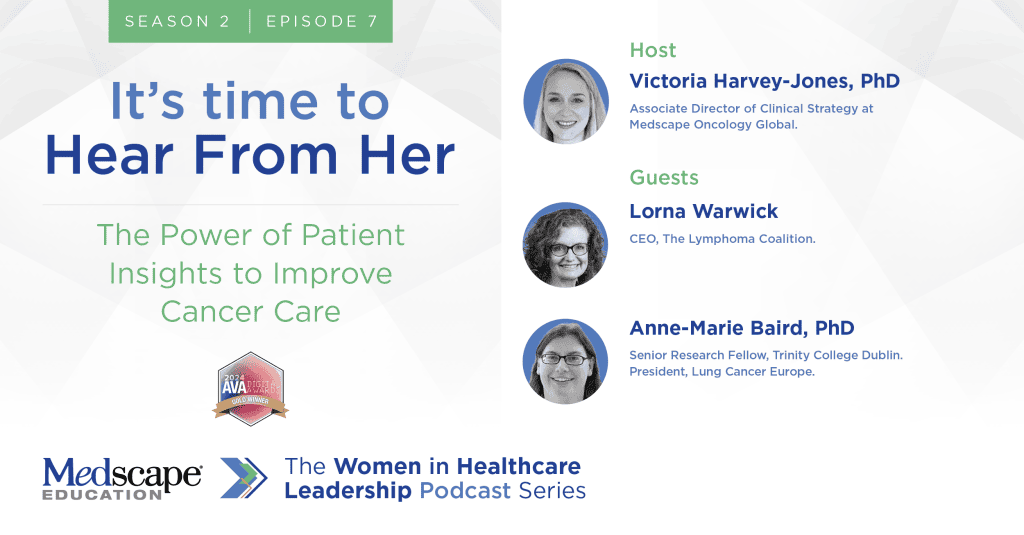
The role of The Lymphoma Coalition is to “generate and provide trusted information, knowledge, and best practices to influence and improve care” for those affected by the disease, says Lorna Warwick, the coalition’s CEO.
Our mission is to be the voice of Europeans impacted by lung cancer, says Anne-Marie Baird, president of Lung Cancer Europe.
Though they are advocating for patients with different types of cancer, these two inspiring healthcare leaders have a shared passion: to ensure that the patient voice, and patient insights, are integrated into the current knowledge base in order to improve cancer care.
Collecting insights from patient communities—through global surveys, working groups, annual gatherings, focus groups, or community advisory boards—provides valuable learnings from those living with these diseases as well as their family members and caregivers. And sometimes those learnings yield data that differs from that of academic researchers.
Warwick recalls sitting at a congress “and being invited to bring the patient perspective using our data and having this really intense discussion—disagreeing with a leading clinical expert in the area of discussion—and feeling confident because I had the data to counter him and say, ‘No, that’s not actually what the patients are telling us. There’s a gap here that needs to be addressed.’ ” And then having other doctors come up to her later and saying they want to change clinical practice based on her presentation.
Some issues that patients grapple with—nausea, fatigue, fear and anxiety, depression, body image—may be ones that doctors have minimized in previous patient conversations since they’re focused more on medical outcomes. So patients try to handle those things on their own. Warwick says that for optimal care it’s important to have those discussions about how patients are feeling. “I say this to doctors all the time: If you add one thing to the conversation with your patients it’s just to ask them, ‘What’s the one thing that’s really bothering you right now?’” What would improve your quality of life?
Warwick knows this can open up a can of worms because patients may bring up things that are totally outside of a doctor’s comfort zone. But, that doesn’t mean that we still don’t need to have the conversation and help them, she says. What Warwick wants clinicians to know is that advocacy organizations have great resources to give the patients the support that they need, and to have a better experience overall despite the medical outcomes of their disease.
As well as educating policy makers, academic researchers, and clinicians, Baird says her pan-European Organization also tries “to develop tools to equip members to do things at a national level. We want people who are able to help to build capacity, to educate, to help create awareness.” We need expert patients to have a seat at the table with pharma, for clinical trials, protocol developments, whatever it might be, Baird says. Not just at the end to develop patient advocacy leaflets. So they need to be comfortable knowing the terminology and with the conversation so they can bring their “real world, lived experience” into the mix.
This is the 2nd in a two-part conversation with Lorna Warwick, CEO, The Lymphoma Coalition and Anne-Marie Baird, President Lung Cancer Europe. To listen to Part I, click here. Hosted by Victoria Harvey-Jones, Associate Director of Clinical Strategy at Medscape Oncology Global.
To read Medscape Oncology’s white paper on patient centricity and improving cancer outcomes, click here.
Follow us for updates on upcoming podcasts and more insightful conversations.
For more information, please contact Jelena Spyropoulos (Global) or Piyali Shin (US).
About Medscape Education Medscape Education (medscape.org) is the leading destination for continuous professional development, consisting of more than 30 specialty-focused destinations offering thousands of free accredited CME and CE courses for physicians, nurses, and other healthcare professionals.
This content was provided by Medscape Education
Company Details

Latest Content from Medscape Education
Medscape Education Leads the Industry into New Era of Precision Education with Guaranteed Impact
NEWARK, N.J., Feb. 8, 2024 /PRNewswire/ — Medscape Education has just unveiled its pioneering approach to developing and delivering medical education designed to drive guaranteed reach, precision targeting, and impact during this…
Hitting Every Beat—The Power of Education in Heart Failure
Heart failure can be a challenge to manage both for clinicians and patients. It’s a complex condition with various manifestations and presentations, and different disease stages that require different approaches…
Medscape Education Wins Best Practice in Advancing Diversity, Equity, and Inclusion in Medical Education at the 19th Annual NAMEC Best Practice Awards
Medscape Education was a co-recipient of the inaugural Best Practice in Advancing Diversity, Equity, and Inclusion in Medical Education award at the 19th Annual NAMEC Best Practice Awards!Creating education that…
Advancing Patient-Centered Cancer Care Through Education to #CloseTheCareGap
One of the next frontiers in oncology isn’t being explored in a lab. Instead, it’s advancing in hospitals and private clinics around the world, thanks to the hard work of…
Medscape Education’s Dedication to Delivering Impact to be Highlighted at Alliance Annual Meeting 2024
Being an active part of the continuing medical education community is a top priority for the Medscape Education team. As part of their commitment to sharing their insights and learnings…
We Can Shorten the Journey
During the shortest month of the year, Medscape Education is making a renewed commitment to use clinician education to help shorten the diagnostic and treatment journey for the millions of…
Making an Impact at ASH 2023
Medscape has left behind the sunny skies of San Deigo, having attended their final conference of the year at the ASH annual meeting.The team wrapped up the year with a…
Women’s Health Faces Some Difficult Headwinds. Here’s How We Can Move Forward
When it comes to women’s health, “we are a bit behind — almost where oncology was 20 years ago and neuroscience was about 10 years ago,” says Sandra Milligan, Head…