




Voices of Change: Women Leading the Menopause Movement
November 20, 2025 | Women in Leadership, Women in healthcare, podcast
For decades, menopause has been swept under the rug, or into the dark corners of clinicians’ offices, often dismissed as something women just had to “get past” and hardly worth discussing. In this episode of “Hear From Her,” learn how three leaders in menopause medicine are building a new standard of care with compassion and education—and shouting their message from the rooftops: Anyone who takes care of women should know about menopause care. Period.
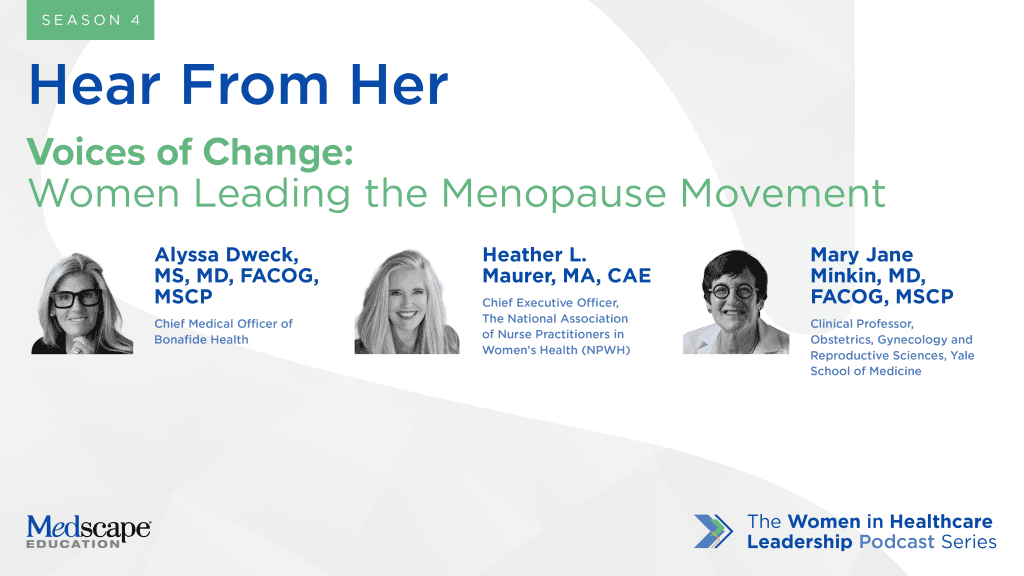
For Dr. Alyssa Dweck, the shift to menopause care came naturally—as stages of life do. As an OB/GYN, she spent her early career delivering babies. But as her patients got older, their health needs changed. “As my patients stopped having babies and started entering perimenopause and menopause, I was growing up with them,” she says. “We didn’t get much training in medical school or residency.” As an underserved space, it was learn-as-you-go.
Heather Maurer’s path into menopause medicine was also shaped by lived experience. As well as being CEO of The National Association of Nurse Practitioners in Women’s Health (NPWH) “I am officially in full menopause,” she says. And looking back, I see missed opportunities in my own care.
“Six years ago I had a frozen shoulder for over a year, and in hindsight I was absolutely in perimenopause. And not once did anyone suggest that it might be estrogen related,” she says. That gap in her own clinical care helped inspire her work to provide continuing education through NPWH for advanced practice providers. Practitioners need evidence-based education and tools to raise the standard of women’s care, she says.
The menopause desert
Dr. Mary Jane Minkin, also an OB GYN, recalls the abrupt halt in menopause education when the 2002 Women’s Health Initiative (WHI) study was published. The study (suggesting that HRT increased risks for breast cancer, heart disease, and stroke, but whose findings were later revealed to depend on many factors), stirred up tremendous fear with both clinicians and patients about hormone replacement therapy. “Menopause education stopped on a dime,” Minkin says.
Around the same time, residency programs were trying to shorten their hours. “And if no one’s taking hormones, then why bother teaching about menopause?” So menopause training went out the window. Twenty years later, Minkin says, we’re still trying to dig out of that hole. We are still in a menopause desert.”
Reshaping menopause care
Historically, women have been excluded from clinical trials, says Maurer. “There’s very little research done specifically in women. [We] were sort of considered little men in terms of extrapolating results and applying them to women’s health, which really just isn’t the case.”
Despite these challenges, the landscape is shifting largely thanks to these passionate women’s healthcare leaders. Patient advocacy, workplace awareness (yes, more toilets and cooler room temperatures go a long way, they say), and entrepreneurial innovation are shining a light on menopause care. Telehealth platforms dedicated to perimenopause and menopause are expanding access. Private companies like Bonafide, where Dweck is Chief Medical Officer, are investing in research and creating products offering hormone-free menopause symptom relief for women. Nurse practitioners are stepping into leadership roles, particularly in underserved areas, to bridge care gaps.
“We have more than 13,000 women’s health nurse practitioners in the U.S., many working in rural or federally qualified clinics,” says Maurer. They are critical in helping women access both treatment and education, and encouraging patients to bring information back to their care teams.
“As a patient, I bring studies to my primary care person who’s not a WHNP or an OB GYN and say, ‘Hey, here’s all this great information about menopause and perimenopause.’” In today’s world, physicians have like 15 minutes for each patient appointment, Maurer says, and everyone has to play a part in maximizing that time.
All three women believe that menopause shouldn’t require specialists at all, and that women’s health should be a standard pillar of medical practice. “It’s basic healthcare, and every provider should know about this,” Minkin says. It’s a chapter in every woman’s life if they’re lucky enough to live that long. “More women will go through menopause than will ever have a baby.”
Adds Maurer: “Anyone who takes care of women should know about menopause care. Period.”
For more information, or to find a menopause specialist in your area, go to menopause.org.
Follow us for updates on upcoming podcasts and more insightful conversations.
For more information, please contact Jelena Spyropoulos (Global) or Piyali Shin (US).
About Medscape Education
Medscape Education (medscape.org) is the leading destination for continuous professional development, consisting of more than 30 specialty-focused destinations offering thousands of free CME and CE courses for physicians, nurses, and other healthcare professionals.
This content was provided by Medscape Education
Company Details

Latest Content from Medscape Education
Making an Impact at ASH 2023
Medscape has left behind the sunny skies of San Deigo, having attended their final conference of the year at the ASH annual meeting.The team wrapped up the year with a...
Women’s Health Faces Some Difficult Headwinds. Here’s How We Can Move Forward
When it comes to women’s health, “we are a bit behind — almost where oncology was 20 years ago and neuroscience was about 10 years ago,” says Sandra Milligan, Head...
A “Leaky Pipeline” and the Loss of Talented Female Physicians
A leaky pipeline that begins during medical school and extends throughout the training process means we lose many talented women, says Fatima Rodriguez, director of preventive cardiology and associate professor...
Medscape Oncology’s Large Presence at ASH 2023
Medscape Education is returning to the annual ASH conference with eight symposia, two publications, and the opportunity for clinicians to challenge their knowledge with MedChallenge.The eight symposia will be held...
Medscape Education Redefines Standards with Website Redesign
Medscape Education—the number 1 destination for CME—--has launched a redesign of its education hub. The site now features easy-to-navigate categories, a highlight on curricula, and enhanced search capabilities, allowing Medscape...
The Power of the Partnership: How Patient-Centricity Improves Care
How can the patient’s voice improve care?This was the question Medscape Oncology Clinical Strategist Victoria Harvey-Jones, PhD and Lesley Fallowfield DBE, BSC, DPHIL, FMEDSCI, Professor of Pyscho-Oncology, Sussex Health Outcomes...
World AIDS Day 35: Medscape’s Commitment to the Elimination of HIV through Education and Looking Towards the Future
December 1 marks the 35th year commemorating World AIDS Day, and the theme is “Remember and Commit.” While new infections have steadily declined over the last several years, HIV remains a...