



Why Modern Dermatology Demands Curiosity Over Precision
August 5, 2026 |
In the high-stakes world of healthcare research and product development, success has long been measured by rigid definitions of precision and predictable trajectories. However, as Dr. Hawa Dumbuya, Director of Clinical Research and Medical Affairs for La Roche-Posay, and board-certified dermatologist Dr. Zoe Diana Draelos share on Hear From Her, the future of medicine belongs to those who are comfortable with career exploration, continuous learning, and human intuition.
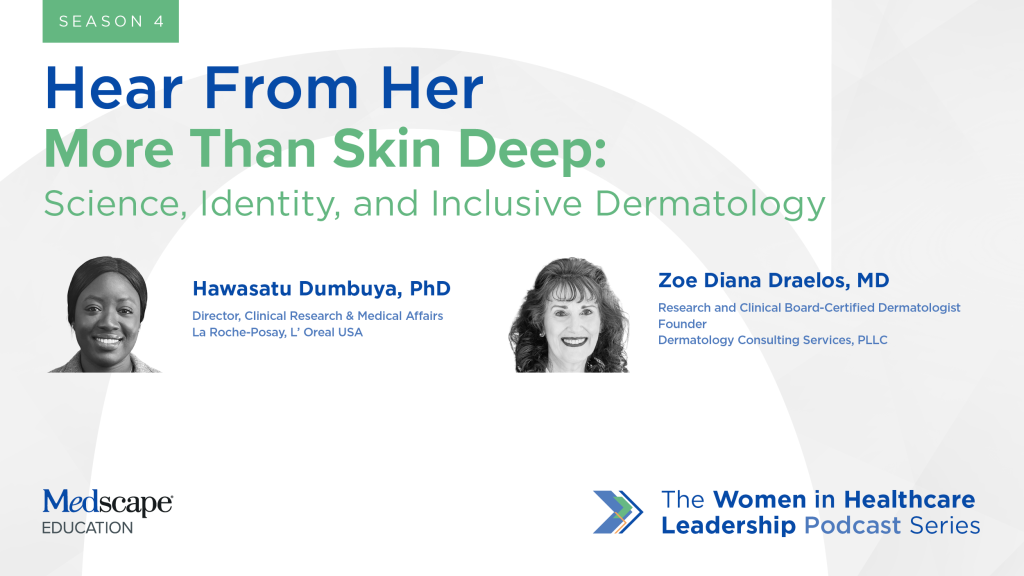
Listen to the full episode here.
The Myth of the Straight Academic Path
For women entering STEM, the pressure to have a lifelong plan mapped out early can feel daunting. Yet, both guests emphasize that non-linear paths often yield the most impactful leaders . Dr. Draelos began her journey exploring classical music and mechanical engineering before shifting to medical school, eventually finding her home in a visual, people-centric field where engineering models are used daily to evaluate material mechanics like hair diameter . Similarly, Dr. Dumbuya moved from Sierra Leone to France and eventually to the United States, transitioning from an aspiration to be a pediatrician to earning her PhD studying UV-induced melanin synthesis, before ultimately moving to corporate industry to drive translational, patient-centered product development.
Listen to the full episode here.
Leveraging AI Without Losing the Human Compass
A major focal point of their conversation centers on the intersection of technology and patient care. While AI is poised to play a role in rapidly iterating chemical formulations, synthesizing sustainable botanical ingredients, and optimizing diverse clinical trial recruitment, the experts offer a vital caution: technology has no moral compass or clinical judgment . Because every dermatological disease presents visually, true diagnosis relies on intuitive clinical reasoning that an internet-scraping algorithm simply cannot replicate.
Navigating Careers in Decades
For women trying to balance professional growth with personal milestones, Dr. Draelos offers a powerful piece of advice: you can have it all, but not at the same time. By viewing a professional life in ten-year segments and allowing goals to evolve, women can remain continuously challenged and invigorated without burning out.
Ultimately, true leadership in skin science isn’t about finding a safe space on a corporate ladder, it’s about staying intensely curious, building professional alliances through mentorship, and having the courage to bridge the gap between rigorous laboratory data and real-world human empathy.
This content was provided by Medscape Education
Company Details

Latest Content from Medscape Education
Medscape Oncology Launches Inaugural Medscape Fellows Program at ASCO 2024
Medscape Oncology is excited to announce the launch of the first-ever Medscape Fellows Program at the 2024 ASCO meeting in Chicago, Illinois. This groundbreaking program aims to nurture young oncology…
Navigating Food Allergy Management: Trends, Treatments, and Decision-Making
Are you having trouble navigating the management of food allergies? Join our faculty experts for a live conversation on social media to learn about the evolving complexities in food allergy…
The Power of Patient Insights to Improve Cancer Care
Two global patient advocacy groups—The Lymphoma Coalition and Lung Cancer Europe— are compiling data from their communities on the real-world experience of living with cancer. What the data reveals sometimes…
Medscape Education Continues Its Patient-Centric Mission at EHA 2024
Anticipation is building at Medscape Education as the team prepares for the EHA 2024 Congress. Medscape Education is excited to announce a significant presence during the congress including a Medscape…
Getting in-sync with Public Health at SYNC 2024
Medscape Education is bringing its public health efforts to Washington, DC for the SYNC conference on HIV, HCV, STIs, Harm Reduction, and LGBTQ health. During the conference, Lindsey will present…
Medscape Education and KDIGO Nephrology Collaboration Accelerates Improvements to Patient Care
Ahead of the 61st European Renal Association (ERA) Congress, Medscape Education and KDIGO (Kidney Disease: Improving Global Outcomes) announce an educational collaboration through a series of webinars to improve anemia-related…
Medscape Brings Impact and Data to ESPGHAN
The ESPGHAN Congress in Milan was full of impact as Medscape Education Global presented 5 scientific posters examining the outcomes of their education. The posters detailed the impact Medscape Education…
Empowering Nurses Through Education
Nurse education is powerful and makes an impact.
Pioneering Paths: Women Leadership in Rare Disease
Rare diseases are often thought of as affecting one in 100,000 or one in 1,000,000 people, and that is true for some conditions. But there are many rare diseases that…
TRANSFORMING CME IMPACT: MEDSCAPE’S GAME-CHANGING APPROACH
It’s time for the CME industry to evolve. During recent years, access to data, modern technologies, and methodologies have allowed for deeper analysis of data and a better understanding of…