




When what matters to patients is hard to measure
September 15, 2026 | EU HTA, JCA, JSC, Joint Clinical Assessment, Joint Scientific Consultation, clinical trials
Patient-relevant outcomes sit at the heart of the EU HTA reforms, but ensuring they reflect lived experience requires you to look beyond what traditional clinical endpoints measure.

In the first post in this series, we looked at how the EU HTA reforms give patients a seat at the table, and how having a seat is only the beginning. The bigger question is what patients bring to the discussion, and whether the outcomes that matter most to them are the ones that assessments are actually measuring.
The Joint Clinical Assessment puts ‘patient-relevant outcomes’ at the centre. In practice, this means looking beyond standard clinical endpoints to the benefits, burdens and trade-offs that matter to patients. The opportunity is for patients to help shape that conversation early, including through Joint Scientific Consultation.
It’s a good principle. The challenge is making sure those outcomes reflect what patients actually experience. Because the outcomes that appear in a clinical dossier, and the outcomes patients talk about when nobody is handing them a questionnaire, aren’t always the same thing.
Across more than 60,000 posts and 145,000 comments from public patient discussion on Reddit’s cancer communities,* we measured the outcomes patients mention most often. Survival is undoubtedly one of them. But it’s only one thread in a much larger conversation.
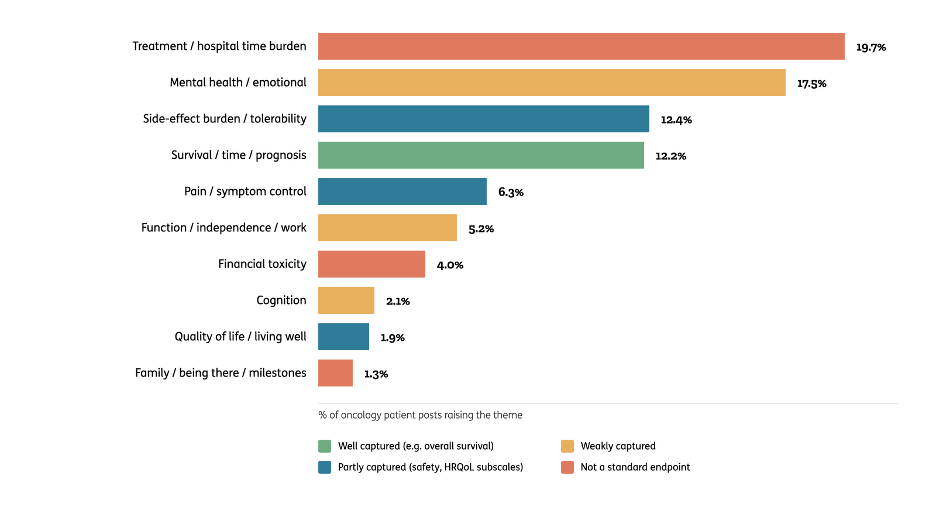
Survival matters, but it isn’t the whole conversation
The most common theme wasn’t the disease itself. It was the treatment, and more specifically the practical burden of living with it. Hospital appointments, infusions, scans, the back-and-forth, the waiting. Nearly one in five posts highlighted some aspect of this burden.
‘I went to the ER as a chemo patient with a fever,’ one person wrote, ‘and learned what happens when you do that.’ That’s an afternoon, or often a whole day, that no survival curve records.
Close behind came the emotional impact of cancer, then the daily burden of side effects. Survival and remission mattered too, deeply. But they were one part of a wider picture: can I work, can I drive, how will I cope financially, who looks after the kids, am I still myself? These are outcomes too. They shape how a treatment is experienced, even when they are harder to capture than traditional endpoints such as overall survival, progression-free survival or response rate.
Patients describe quality of life, even if they don’t call it that
HTA and clinical research already try to capture some of this wider experience, often through quality-of-life questionnaires. But patients don’t usually describe their lives in questionnaire language. Fewer than two posts in a hundred explicitly mentioned the phrase ‘quality of life’. Instead, they talked about what it meant in practice – lifting weights again, being there for family milestones, or being given ‘three to six months of normal life.’
Normal life. That’s the outcome, in the words people actually use. Not as a score, domain, or questionnaire result, but as something recognisable and personal. It’s the kind of thing that can be difficult to fully capture through even the best validated questionnaires.
That is the difficult part for any assessment framework. It has to translate these lived experiences into evidence that can be collected consistently and compared fairly. That’s precisely why patient input matters during scoping and evidence-generation discussions. It helps ensure that what gets measured reflects what patients actually live with.
Patient experience is rarely one emotion at a time
The data revealed something else, too. When the posts were scored for emotional tone, the most common states weren’t single feelings. They were combinations: frustrated but persisting, concerned but hopeful, cautious but optimistic. Living with cancer was rarely described as one thing at a time. More often, it appeared to be several things at once.
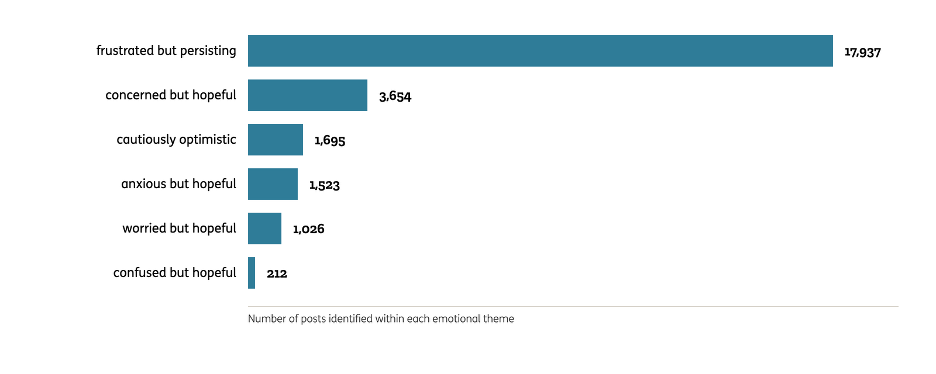
This is important, because value assessment often needs to reduce experience to one number: a utility, a score, a single point on a scale. The lived reality is often two things held together at once.
A treatment can give someone more time and still make that time harder to live through. That experience is difficult to capture in a single score.
The patient, and the people around them
The patient comes first; that isn’t in question. But a meaningful share of the experience is voiced by someone close to them — a husband, a daughter, a parent — sometimes speaking for a patient too unwell to post, more often standing alongside them. In our dataset, around a third of the first-person accounts appeared to come from caregivers.
The patient should remain at the centre. But in cancer, the people around them often see important parts of the experience too: the travel, the waiting, the side effects after treatment, the changes in daily life. Their perspective can help show how a treatment is actually lived with.
What this means in the new system
None of this argues against survival data, or against the reforms. It argues for what the reforms set out to do. The Joint Clinical Assessment, and the earlier Joint Scientific Consultation where evidence-generation plans are discussed, both create opportunities for patient input. Its value lies in highlighting outcomes that can be harder to see through conventional clinical endpoints alone: treatment burden, emotional impact, day-to-day function, time and financial pressures.
That input has to be built in early. It comes from patients and the organisations that represent them, involved soon enough to shape what gets measured, not so late that they can only respond to what’s already there. When this happens, ‘patient-relevant outcomes’ can mean outcomes that are genuinely relevant to patients. Without it, assessment risks reflecting the outcomes our existing instruments were already designed to capture.
Ready to talk?
If you’re preparing for a Joint Clinical Assessment and want patient involvement to shape what gets measured, not just respond to what has already been measured, let’s talk.
*Analysis is based on more than 60,000 posts and 145,000 comments from public patient discussions across Reddit cancer communities covering major tumour types (including breast, colorectal, lung, lymphoma, myeloma and more), captured in our patient-voice index as of June 2026. To explore the outcomes patients talk about most often, we measured the frequency with which different outcome themes appeared in discussions and reviewed representative posts to understand how patients described their experiences in their own words.
For Figure 1, the assessment of how well each outcome theme is captured by conventional clinical trial and HTA endpoints is qualitative, not quantitative. Themes were classified using a four-level scale (well captured, partly captured, weakly captured, or not a standard endpoint) based on whether they are typically reflected in routine oncology measures such as overall survival, progression-free survival, response rate, safety/adverse event reporting, and validated health-related quality-of-life instruments.
For Figure 2, posts were analysed using machine-assisted classification to identify emotional themes and combinations of emotional states. The same approach was used to distinguish patient and carer perspectives.
As the data comes from self-selected, anonymous users, it is not statistically representative of the wider cancer population. Outcome themes were identified using keyword- and theme-based analysis, meaning some concepts, particularly those expressed indirectly, may be under-represented. The findings should therefore be interpreted as an indication of the issues patients choose to discuss in their own words rather than a population-level estimate. Quotes are real, lightly edited for brevity, and de-identified.
References
EUR-Lex. Regulation (EU) 2021/2282 on health technology assessment (HTA Regulation). 12 January 2025. Available here. Accessed August 2026.
European Union. Implementation of the Regulation on health technology assessment. 2024. Available here. Accessed August 2026.
This content was provided by Cuttsy + Cuttsy
Company Details

Latest Content from Cuttsy + Cuttsy
It was never reluctance: What ASCO 2026 revealed about clinical trial recruitment
ASCO 2026 highlighted that low clinical trial recruitment is driven less by patient reluctance and more by gaps in awareness, communication, accessibility and patient education.
Where translation falls short in practice
Discover why translation alone is not enough in global clinical trials and how expert localisation improves participant understanding, trust and engagement.
Where it all began – why we developed The Experience Gap
Learn how The Experience Gap was developed to help sponsors, CROs and site teams improve clinical trial participation by identifying friction points, enhancing patient experience, and driving better recruitment and…
Cuttsy+Cuttsy launches a practical roadmap to enhance clinical trial participant experience
Cuttsy+Cuttsy has launched The Experience Gap, a practical roadmap designed to help clinical trial teams improve participant engagement, support and retention across the full study journey.
Cuttsy+Cuttsy welcomes three new experts to the team
Cuttsy+Cuttsy is happy to be welcoming three new people to the team this month.
The gap between hype and reality, what patients really say about weight loss drugs
Explore real patient conversations about weight loss drugs, uncovering challenges, support strategies, and the critical need for clear, reliable healthcare communication.
Why patient-centricity depends on site-centricity in clinical trials
Explore why patient-centricity in clinical trials relies on site-centricity, emphasising the need to design trials that empower site teams to better support patients.
From cloudy to clear: visualising complex data privacy information
Discover how clear communication principles can transform complex clinical research topics, as we conclude our Health Literacy series with a practical example on participant data transparency.
UK clinical trial regs are changing — here’s what’s happening
Discover the transformative updates to UK clinical trial regulations, effective from April 2026, and learn how they aim to enhance transparency, participant safety, and trial efficiency.
The invisible influence on trial retention: why caregivers must be part of the plan
Caregivers are vital to clinical trial retention, yet often overlooked—this article highlights their challenges, impact, and how to better support them.