




New Cuttsy+Cuttsy research shows why site support matters more than ever
February 23, 2026 | Participant engagement, Site staff, clinical trials, patient engagement, research
Cuttsy+Cuttsy’s upcoming report, ‘The site factor: Where protocol meets practice in clinical trials’, delves into the critical role of site staff in clinical research, offering insights into their daily challenges, opportunities, and the human connections that drive successful trial outcomes.
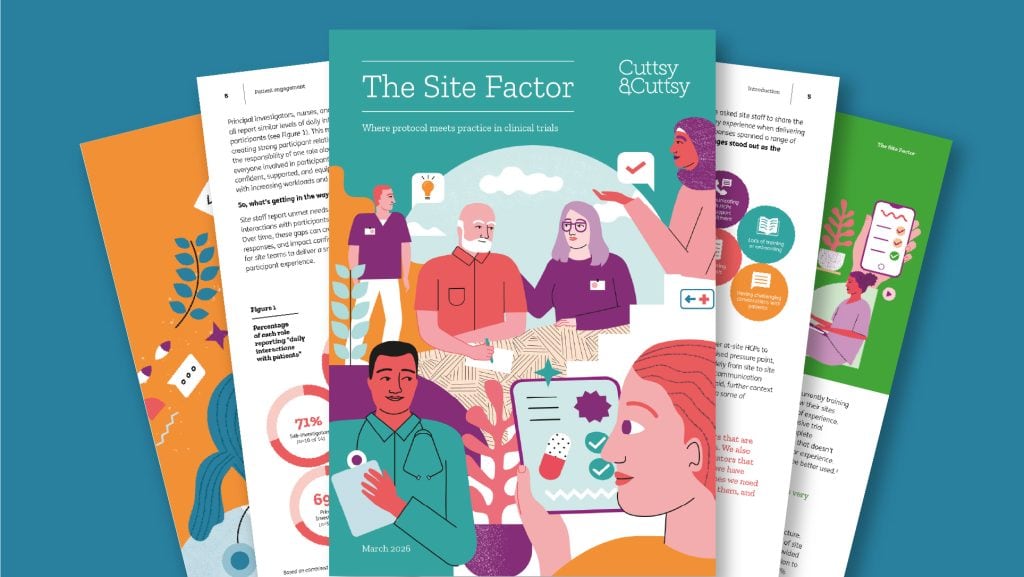
Cuttsy+Cuttsy today announced the upcoming release of their new report – The site factor: Where protocol meets practice in clinical trials. The report shines a light on the daily realities of clinical research, focusing on the site staff who make every trial possible. Building on insights from the 2025 report The participation equation, it explores the next layer of what it takes to deliver meaningful clinical trial experiences.
Based on research with site teams across eight countries, the report seeks to explore the everyday challenges and opportunities shaping clinical trial delivery, focusing on the crucial interactions between site staff and study participants, and the human connection that underpins successful study outcomes.
Building on this, the report looks closely at the realities of site roles, from interpreting protocols to supporting participant engagement. It highlights where site teams feel supported and where there are still gaps, and points to clear opportunities for the industry to better equip and empower these essential teams in ways that enhance and strengthen the participant experience.
‘We know that the relationship between a participant and their study team is a crucial factor in trial retention, but the site team perspective is not always fully reflected in how trials are designed and supported’, says Stacey Davidson, Head of Content and Strategy. ‘This report brings that perspective into focus, highlighting what site teams need to feel confident and equipped, and why that matters for the participant experience and ultimately, the success of clinical trials.’
The site factor is intended to be a practical resource for sponsors, CROs, and others involved in clinical trial management. It offers a clear snapshot of the day-to-day realities of site staff work and explores what meaningful support looks like in practice, reinforcing the work that site teams are already doing and helping improve how participants experience clinical trials.
Sign up to receive the full report when it’s released in March 2026.
This content was provided by Cuttsy + Cuttsy
Company Details

Latest Content from Cuttsy + Cuttsy
Invited, but not equipped: patient involvement needs more than an open door
Explore how pharma can help patients and patient organisations prepare for meaningful involvement in EU HTA without shaping their contribution.
The outcomes are already chosen. So when can patients really shape them?
Explore why involving patients early in Joint Scientific Consultations is critical to shaping the outcomes measured in clinical trials.
Long-term clinical trial engagement is a behavioural challenge – not just an informational one
Explore why long-term clinical trial engagement is a behavioural challenge, showing how proactive support from site teams can help participants stay connected, confident and committed throughout a study.
Patients are telling the truth — just not to you
Patients are often most honest outside the clinic—revealing vital insights that can help clinical trial teams build trust, improve participation and collect better data.
When what matters to patients is hard to measure
Patient-relevant outcomes sit at the heart of the EU HTA reforms, but ensuring they reflect lived experience requires you to look beyond what traditional clinical endpoints measure.
Permission to pause: making treatment breaks part of the cancer care conversation
Exploring how empathetic, patient-centred communication can make planned treatment breaks easier to discuss as part of cancer care.
A seat at the table: what the EU HTA reforms really ask of patient involvement
The EU HTA reforms give patients a formal role in assessing new medicines, but meaningful involvement requires more than simply offering them a seat at the table.
Why faster trials make participant understanding more important than ever
As clinical trials accelerate, clear, accessible consent is essential to help participants understand, engage with and remain in a study.
Older trial participants reject bad design, not technology
Older trial participants aren’t rejecting digital technology — they’re rejecting poorly designed, inaccessible experiences that make participation harder.
5 key takeaways from the Patient Centricity and Engagement Conference
Key takeaways from the Patient Centricity and Engagement conference, exploring how trust, inclusion and meaningful partnership can help turn patient engagement from intention into action.